
When people think about a business’s brand, the first thing that often comes to mind is the logo. Maybe it’s the sign out front, the colors used on the building, or the company name. But your brand doesn’t live in just one place.
From business signage and vehicle graphics to printed materials and storefront displays, every visual touch point contributes to how customers recognize your business. A potential customer might first notice your truck while sitting at a traffic light. Later, they may drive past your building, visit your office, pick up a brochure, or see your booth at a local event.
Each interaction gives them another opportunity to recognize your business and form an impression of it. That’s why brand consistency matters.
To keep your business branding consistent, use the same core logo, colors, fonts, and visual style across your building signage, vehicles, windows, interior spaces, printed materials, and event displays. Before creating something new, consider how it fits with what you already have so each piece strengthens the same recognizable identity.
For businesses throughout Binghamton, the Southern Tier, and surrounding communities, those customer touchpoints can happen just about anywhere, from your storefront and job sites to community events and vehicles traveling around town. Consistency doesn’t mean putting your logo on every available surface or making every piece of marketing look exactly the same. It means making sure the different ways customers encounter your business feel connected.
Where Should Your Business Branding Stay Consistent?
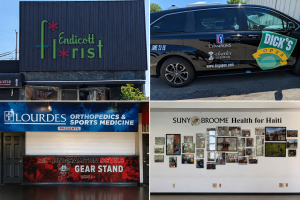
Business Brand Consistency Across Signs, Vehicle Graphics and Displays
When reviewing your visual brand, consider these seven areas:
- Building and exterior signage
- Company vehicles
- Windows and doors
- Interior signage and graphics
- Printed marketing materials
- Event and community displays
- Future signage and marketing projects
Looking at these pieces together can help you identify inconsistencies and decide where improvements will make the biggest difference.
1. Start With Your Building and Exterior Signage
For businesses with a physical location, exterior signage is often one of the most visible representations of the brand.
A good business sign needs to do the practical job of helping people find you, but it should also accurately represent your business. Your logo, colors, fonts, and overall design should feel consistent with the rest of your materials. It’s also worth looking beyond the main sign.
Entrance signs, parking signs, hours, directional signage, and other exterior elements may have been added at different times. Over the years, that can leave a business with several different styles competing for attention. You don’t necessarily need to replace everything at once. Looking at all of your signage together can help identify which pieces need attention first and which ones are already doing their job well.
If you’re opening a new business or location and aren’t sure where to begin, our Beyond the Sign: 7 Ways to Keep Your Brand Consistent takes a closer look at the different types of signage a business may need.
2. How Can Vehicle Graphics Strengthen Brand Consistency?
Your building stays in one place. Your vehicles don’t. Whether you have one work truck or an entire fleet, vehicle graphics give your brand an opportunity to travel throughout the communities you serve.
That can mean a full or partial vehicle wrap, but it doesn’t have to. Vehicle lettering, a recognizable logo, and clear contact information can create a professional appearance without covering an entire vehicle. The important part is making sure the design feels like your business.
If someone sees your vehicle at a job site and later visits your storefront or encounters another piece of your marketing, they should be able to recognize that they’re dealing with the same company. For businesses with multiple vehicles, using consistent vehicle graphics also helps turn individual trucks, vans, or cars into a recognizable fleet.
3. Carry Your Branding onto Your Windows and Doors
Once someone reaches your business, your windows and doors become another opportunity to reinforce your identity. Window and door graphics can display your logo, business hours, contact information, services, or other important information while helping your storefront feel complete.
They can also be used for temporary promotions, seasonal messaging, or privacy where needed. These details may seem small compared with a large exterior sign, but they’re often viewed much more closely by customers. Keeping them visually connected to your overall brand helps create a consistent experience from the parking lot to the front door.
4. How Does Interior Signage Support Your Brand?
Brand consistency shouldn’t stop once customers step inside.
Lobby signs, dimensional lettering, wall graphics, directional signage, room identification, and branded displays can all contribute to the experience someone has inside your space.
Interior signage also serves an important practical purpose. Customers and visitors should be able to understand where they’re going and find what they need without confusion. Effective interior signage can accomplish both goals: making a space easier to navigate while reinforcing the identity of the business.
This can be especially valuable in offices, medical facilities, retail spaces, schools, municipal buildings, and other locations where customers or visitors regularly move through a building.
5. How Do Printed Materials Support a Consistent Brand?
Brand consistency shouldn’t disappear when something comes off the printer.
Business cards, brochures, fliers, menus, sales materials, event handouts, and other printed marketing materials are often taken away from your business and viewed later. That makes them another important part of how people remember your organization. They don’t all need to use exactly the same layout, but they should have common visual elements that make them recognizable.
Using consistent colors, fonts, logos, and design elements can make a collection of separate materials feel like they belong together. This is also why having high-quality logo and artwork files matters. When the people creating materials for your business are working from the same approved assets, it’s much easier to maintain a consistent appearance from one project to the next.
6. Bring the Same Brand to Events and Into the Community
Local businesses don’t only interact with customers at their own locations.
You may sponsor a community event, attend a trade show, set up at a fair, participate in a fundraiser, or support a local organization. Banners, sponsor signs, table displays, temporary signage, handouts, and other event materials become another representation of your business.
If your storefront has one look, your vehicles have another, and your event materials introduce a third, you’re missing an opportunity to build recognition. Using consistent branding helps connect those interactions. Someone who sees your business represented at a community event today may be more likely to recognize your vehicle, storefront, or name later.
7. How Can You Keep Branding Consistent as Your Business Grows?
Most inconsistent branding isn’t intentional. It happens gradually.
A business orders a sign when it opens. A few years later, someone creates a banner. Then a vehicle needs lettering. New business cards are ordered. A promotional event comes up quickly, so another piece gets designed.
Before long, the business may have several slightly different logos, colors, fonts, or styles in circulation. Before starting your next sign, graphic, or print project, it can help to look at the entire picture.
Ask yourself:
- Are we using the same version of our logo?
- Are our colors and fonts consistent?
- Do our vehicles look like they belong to the same company as our storefront?
- Do our printed and event materials reinforce the same visual identity?
- Are there older pieces that no longer accurately represent the business?
You don’t have to overhaul everything at once. Creating consistency can happen piece by piece. The important thing is having a direction, so each new project strengthens the brand instead of introducing another variation.
Why Does Brand Consistency Matter?
Brand consistency helps make a business easier to recognize.
When customers repeatedly encounter the same visual identity across your business signs, vehicle graphics, printed materials, and physical spaces, those individual interactions begin to connect.
That familiarity can reinforce a professional, established presence and make it easier for customers to remember who you are. Your sign may be where that recognition begins, but it isn’t the whole brand. From your building and vehicles to your windows, interior spaces, printed materials, and event displays, every visual touch point is another opportunity to reinforce your identity.
Frequently Asked Questions About Business Branding
What does brand consistency mean for a small business?
Brand consistency means using recognizable visual elements, such as your logo, colors, fonts, and overall design style, across the different places customers encounter your business. The goal isn’t to make everything identical. It’s to make everything feel like it comes from the same organization.
Does all of my business signage need to look exactly the same?
No. Different signs serve different purposes and may require different layouts, materials, or sizes. However, maintaining consistent logos, colors, fonts, and other core brand elements help connect those different signs visually.
What should I update first if my business branding is inconsistent?
Start with the pieces customers see most often. Depending on your business, that may be your main exterior sign, company vehicles, storefront, or frequently used printed materials. Reviewing everything together can help you prioritize the updates that will make the biggest difference.
Do I need to replace everything when I update my branding?
Not necessarily. Many businesses can improve brand consistency gradually. Establishing a clear visual direction first allows you to update signs, vehicle graphics, printed materials, and other pieces as they’re replaced or as your budget allows.
What information should I keep on file to maintain consistent branding?
At minimum, businesses should keep current, high-quality versions of their logo and know the primary colors and fonts associated with their brand. Having these assets readily available makes it easier to maintain consistency when ordering new signs, graphics, printed materials, or displays.
Make Every Impression Feel Like Your Business
Your sign may be the first thing someone notices, but it won’t be the last.
Every time someone sees your vehicle, walks through your front door, picks up a brochure, or encounters your business at a community event, they’re getting another piece of the picture.
When those pieces work together, your business becomes easier to recognize and your visual identity becomes stronger over time.
At 3i Graphics & Signs, we help businesses and organizations throughout Binghamton, the Southern Tier, and surrounding communities with more than the sign out front. From custom business signs and vehicle graphics to printed materials, displays, and custom projects, we can help create pieces that work together and consistently represent your organization.
Whether you’re starting something new, refreshing an established brand, or simply wondering which piece needs attention next, contact 3i Graphics & Signs to talk about your project and how all the pieces can work together.
